
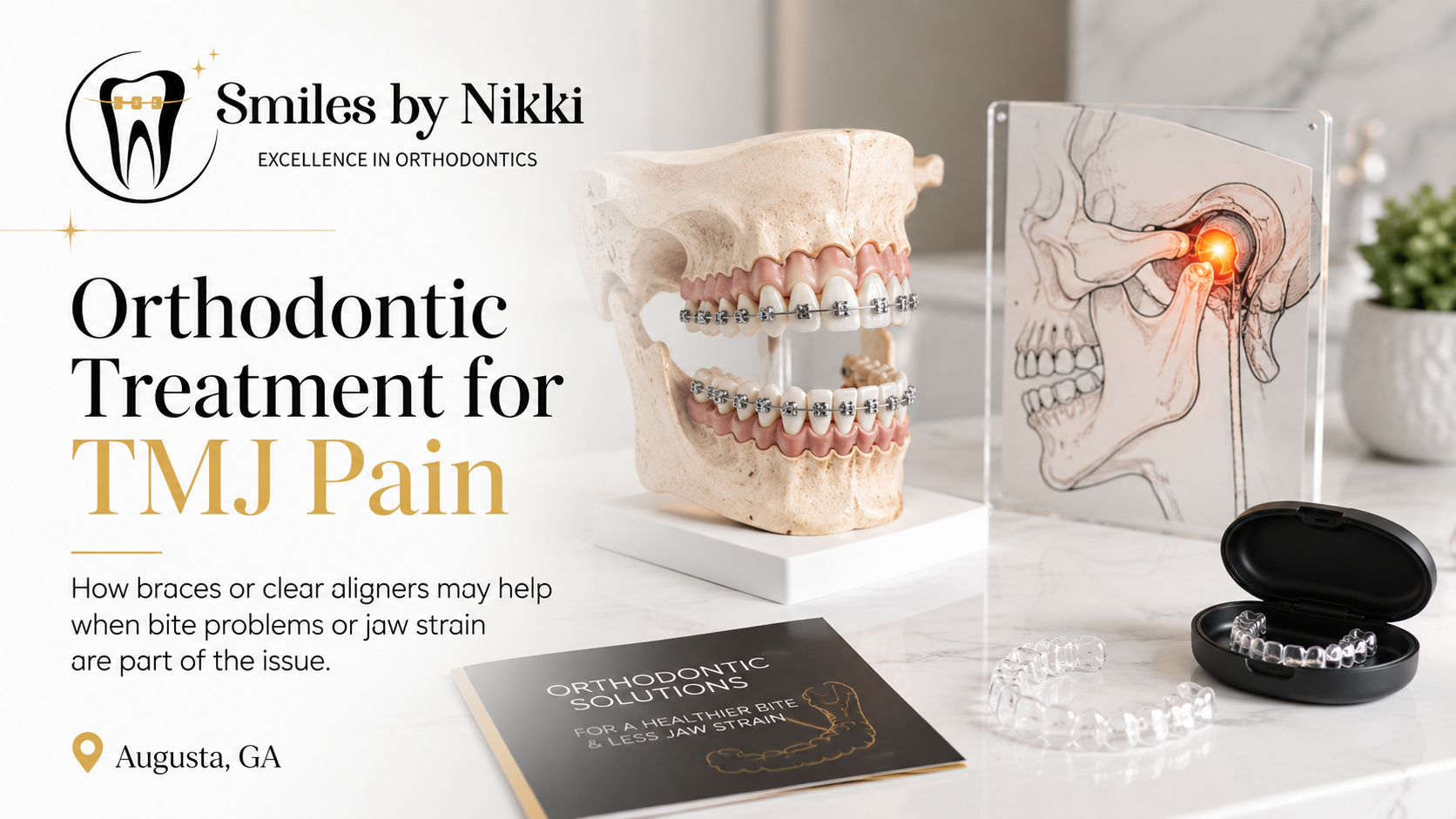
Can Braces or Clear Aligners Help With TMJ Pain?
Quick Answer: Braces and clear aligners can correct orthodontic problems, but they are not established treatments for TMD or general jaw pain. An orthodontist can determine whether a separate alignment or bite concern needs treatment, while persistent pain, locking, swelling, or limited movement may require another dental or medical provider.
What Is the Difference Between TMJ and TMD?
TMJ refers to the temporomandibular joint, which connects the lower jaw to the skull and helps the mouth open, close, and move from side to side. TMD refers to a group of disorders involving the jaw joints, chewing muscles, or nearby structures.
People often use “TMJ” to describe jaw pain, tightness, clicking, popping, or difficulty opening the mouth. Painless clicking is common and does not always need treatment, but pain, locking, swelling, or limited movement should be evaluated.
Can Orthodontic Treatment Cure TMD?
Braces and clear aligners should not be presented as cures for TMD. Jaw discomfort can be related to muscle tension, clenching, grinding, stress, injury, inflammation, arthritis, or another dental or medical condition. More than one factor may be involved.
Research does not support assuming that crowding or a misaligned bite directly caused a person’s TMD. Permanent changes to the teeth or bite should not be the routine first response to unexplained jaw pain.
A patient may still need orthodontic care for a separate condition, such as significant crowding, spacing, tooth shifting, crossbite, open bite, or another malocclusion. In that situation, the goal is to correct the orthodontic problem rather than promise relief from jaw symptoms.
What Can an Orthodontist Evaluate?
During an orthodontic consultation, Dr. Nikki Sangha can examine tooth alignment, crowding, spacing, bite relationships, visible tooth wear, previous orthodontic relapse, and how the upper and lower teeth fit together.
The consultation may also include questions about jaw pain, clicking, locking, clenching, grinding, headaches, or changes in movement that could affect treatment planning. An orthodontic examination may document these concerns, but it may not identify the exact cause of the discomfort.
If an orthodontic condition is present, Dr. Sangha can explain whether braces, clear aligners, monitoring, or another orthodontic option may be appropriate. Persistent or complex jaw symptoms may need evaluation by a dentist, physician, or clinician experienced in TMD or orofacial pain.
When Might Braces or Clear Aligners Be Appropriate?
Braces and clear aligners may be recommended when someone with jaw discomfort also has an orthodontic condition that independently needs treatment.
Braces remain fixed to the teeth and can correct crowding, spacing, rotated teeth, and many diagnosed bite problems. Clear aligners use removable trays and can treat suitable alignment and bite concerns when the required movements can be managed with consistent wear.
The choice depends on the tooth movements needed, oral health, treatment complexity, and the patient’s ability to follow instructions. Expected results may include straighter teeth, corrected crowding or spacing, and improved alignment between the upper and lower teeth. Improvement in jaw pain cannot be predicted because the symptoms may have another cause.
What Care Is Usually Considered for TMD?
Because TMD can have several causes, care often begins with conservative and reversible approaches rather than permanent changes to the teeth or bite.
Depending on the diagnosis, an appropriate dental or medical provider may discuss reducing aggravating habits, temporary dietary changes, heat or cold, exercises, medication, physical therapy, stress management, or a removable oral appliance. These options should be selected with professional guidance rather than started solely from general online advice.
When a patient has both TMD symptoms and an orthodontic problem, treatment may need to be coordinated between the orthodontist and the provider managing the jaw discomfort.
When Should Jaw Discomfort Be Evaluated?
A general dentist or physician is often a reasonable first step for recurring jaw pain. An orthodontist is most relevant when there is also a clear alignment or bite concern, such as significant crowding, tooth shifting, or another diagnosed orthodontic problem.
Arrange an evaluation when jaw pain keeps returning, interferes with eating, or occurs with painful clicking, repeated locking, facial soreness, limited movement, or a noticeable change in how the teeth meet.
Painless clicking without restricted movement is often less concerning. However, clicking that becomes painful, occurs with locking, or worsens over time should be checked.
Seek urgent dental or medical care for a jaw that is locked open or closed, severe swelling, recent trauma, signs of infection, severe pain, or a sudden inability to move the jaw normally.
Frequently Asked Questions
Orthodontic Consultations for Jaw and Bite Concerns
Smiles by Nikki can evaluate tooth alignment, crowding, tooth shifting, orthodontic relapse, and bite concerns in patients who also report jaw discomfort.
If an orthodontic condition is present, Dr. Sangha can explain whether braces, clear aligners, monitoring, or another orthodontic option may be appropriate. Persistent pain, locking, swelling, injury, or limited jaw movement may require evaluation or coordinated care from another provider.