
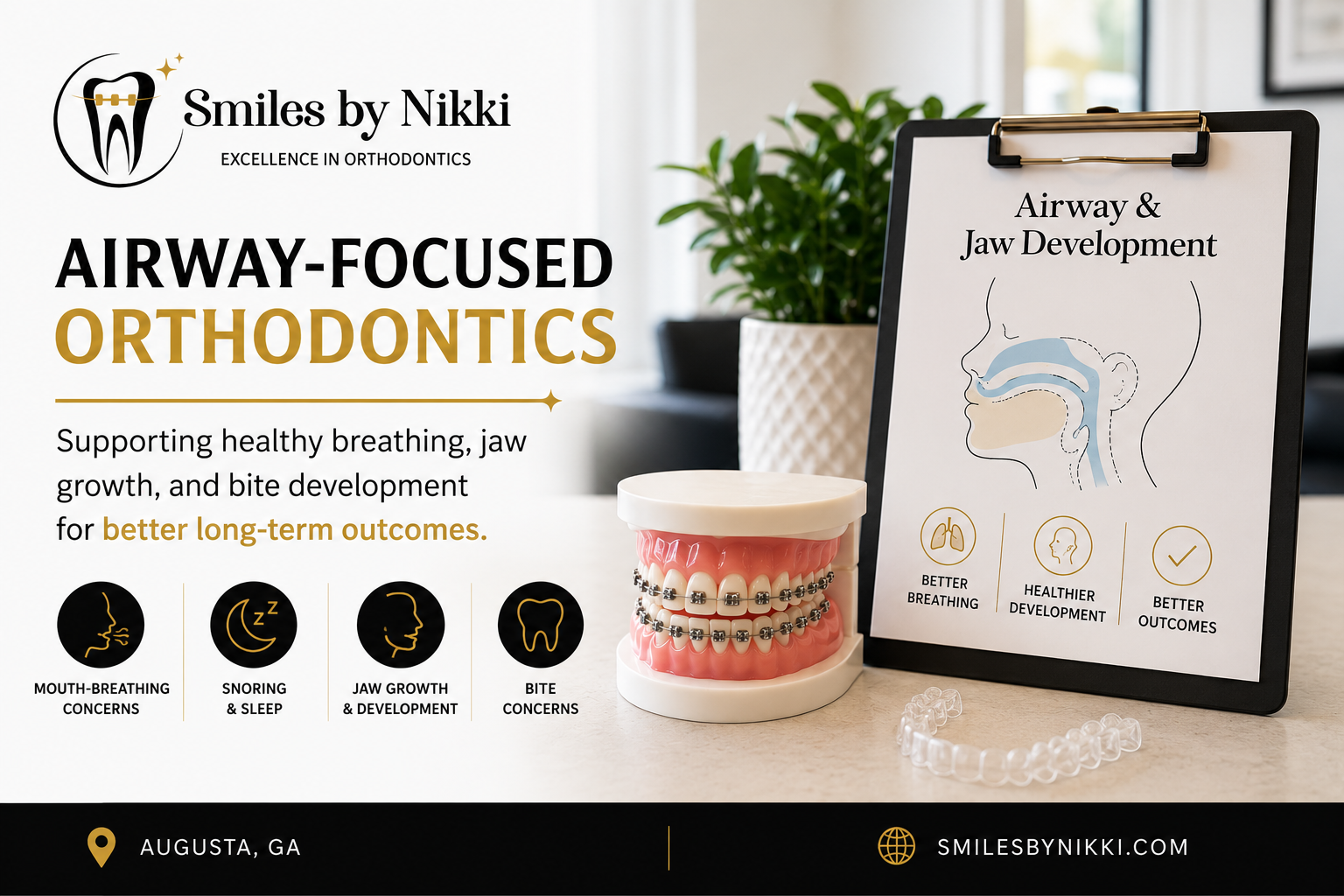
What Is Airway-Focused Orthodontics for Children Who Snore or Mouth-Breathe?
Quick Answer: Airway-focused orthodontics considers a child’s teeth, bite, jaw width, facial growth, and oral posture while also noting symptoms such as mouth-breathing or snoring. An orthodontist can identify concerns such as a narrow upper jaw, crossbite, or crowding and recommend medical evaluation when sleep or breathing symptoms need further assessment. Orthodontic care does not diagnose or independently treat sleep apnea.
What Does Airway-Focused Orthodontics Mean?
Airway-focused orthodontics is an approach that considers sleep and breathing concerns alongside a child’s orthodontic development. It is not a separate medical diagnosis or a substitute for care from a pediatrician, ENT, or sleep specialist.
During an orthodontic evaluation, the orthodontist may review tooth crowding and spacing, jaw width, bite relationships, facial growth, lip and tongue posture, and whether the child has difficulty closing the lips comfortably. Parents may also be asked about mouth-breathing, snoring, restless sleep, or other symptoms they have noticed at home.
These findings do not diagnose an airway disorder. They help determine whether an orthodontic concern is present and whether referral to a medical provider may be appropriate.
What Can an Orthodontist Evaluate?
An orthodontist can evaluate how the teeth and jaws are developing and identify conditions that may benefit from monitoring or treatment. These may include a narrow upper jaw, crossbite, significant crowding, uneven jaw development, open bite, limited space for permanent teeth, or oral habits that affect tooth and bite development.
Some of these findings may occur alongside mouth-breathing or snoring, but they do not prove that the orthodontic condition caused the breathing symptoms.
Screening means reviewing reported symptoms and examining dental and facial development for signs that may justify further evaluation. It does not confirm sleep apnea or identify the exact cause of snoring.
Can Orthodontic Treatment Stop Mouth-Breathing?
Orthodontic treatment does not directly treat every cause of mouth-breathing. Children may breathe through their mouths because of nasal congestion, allergies, enlarged tonsils or adenoids, nasal obstruction, habitual mouth-open posture, an orthodontic concern, or a combination of medical and dental factors.
Medical conditions may restrict airflow through the nose. Orthodontic findings may exist at the same time, but they do not automatically explain why the child is mouth-breathing.
If a confirmed bite or jaw-width problem is present, orthodontic treatment may address that condition. It cannot guarantee that mouth-breathing will stop, especially when allergies, enlarged tissues, or another medical issue is involved.
When Should Snoring Be Discussed With a Pediatrician?
Temporary snoring can occur during a cold or nasal congestion. Parents should seek medical advice when snoring happens frequently, continues after an illness has resolved, is loud or disruptive, or occurs with gasping, choking, pauses in breathing, labored breathing, daytime sleepiness, or behavior changes.
Snoring does not automatically mean a child has sleep apnea. However, frequent snoring or nighttime breathing difficulty should be discussed with the child’s pediatrician or another qualified medical provider.
Seek urgent medical care if your child has prolonged breathing pauses, blue or gray skin, severe difficulty breathing, or another immediate breathing emergency.
Medical Signs and Orthodontic Findings
Parents may notice both sleep-related symptoms and visible dental concerns. These should be evaluated separately rather than treated as proof of one underlying cause.
Sleep or breathing signs that should be discussed with a medical provider include frequent loud snoring, gasping, choking, breathing pauses, difficulty breathing through the nose, restless sleep, daytime sleepiness, morning dry mouth or headaches, and attention or behavior changes. These symptoms can have several possible causes and do not confirm a sleep-related breathing disorder on their own.
Orthodontic findings that may justify an evaluation include a narrow upper jaw, crossbite, significant crowding, open bite, uneven jaw growth, difficulty resting the lips together, or limited space for permanent teeth. An orthodontist can determine whether these findings need monitoring or treatment based on the child’s age, growth, and bite.
Can a Palatal Expander Help?
A palatal expander may be recommended when a growing child has a narrow upper jaw, crossbite, or another confirmed width-related orthodontic problem.
Expansion is intended to address the orthodontic condition. Some children may also experience changes in nasal airflow, but expansion should not be presented as a stand-alone treatment for snoring or sleep apnea.
Persistent sleep or breathing symptoms still need medical evaluation, even if orthodontic expansion is recommended. Parents should not assume that improved jaw width or bite alignment means a sleep problem has resolved.
Why Early Orthodontic Evaluation Can Matter
Children’s teeth and jaws continue to develop as they grow. An early orthodontic evaluation can help determine whether a bite or jaw-development concern should be treated, monitored, or left alone.
Early treatment is not necessary for every child. It may be considered when timing could help address a specific concern, such as certain crossbites, a narrow upper jaw, a growth-related jaw imbalance, severe crowding, or a harmful oral habit.
In other cases, monitoring development may be the most appropriate recommendation. An evaluation around age seven can help identify concerns early, but it does not mean treatment must begin at that age.
What Happens During the Orthodontic Visit?
During an orthodontic evaluation, Dr. Nikki Sangha may review tooth position, available space, jaw width, bite, facial growth, lip and tongue posture, and relevant dental and medical history. Parents may also be asked about snoring, mouth-breathing, sleep quality, and how often the symptoms occur.
Diagnostic photos, X-rays, or other orthodontic records may be taken when needed. Parents should describe what they observe at home and whether the symptoms continue when the child is not sick.
A short video may help communicate what the parent has noticed, but it does not replace a medical examination or sleep study. If the history raises concern for sleep-disordered breathing, Dr. Sangha may recommend that the family speak with a pediatrician, ENT, sleep physician, or another appropriate medical provider.
What Orthodontic Treatment Might Be Recommended?
Treatment is based on an orthodontic diagnosis, not on snoring alone. Depending on the findings, the orthodontist may recommend monitoring growth and tooth development, palatal expansion for a narrow upper jaw or crossbite, treatment for a harmful oral habit, or braces or another appliance for a confirmed bite or alignment concern.
Care may also need to be coordinated with the child’s dentist or medical provider. Braces, aligners, retainers, and space maintainers should not be described as direct treatments for sleep apnea or general breathing problems. They are used when there is an orthodontic reason to recommend them.
Is Airway-Focused Orthodontics the Same as Sleep Apnea Treatment?
No. Pediatric obstructive sleep apnea is a medical condition that should be diagnosed by an appropriate medical provider. A sleep study may be recommended when the child’s symptoms and medical evaluation indicate that it is needed.
An orthodontist can review reported sleep or breathing symptoms, evaluate the teeth, bite, jaw width, and facial growth, treat confirmed orthodontic problems, and recommend medical referral when appropriate. An orthodontist cannot confirm that a child has sleep apnea based only on the appearance of the teeth, jaws, tongue, or face.
Good care may involve coordination between the orthodontist, pediatrician, ENT, sleep physician, dentist, or another appropriate provider.
Frequently Asked Questions
Schedule a Children’s Orthodontic Evaluation in Augusta, GA
Smiles by Nikki can evaluate your child’s teeth, bite, jaw width, facial growth, and orthodontic development and discuss whether monitoring or treatment is appropriate.
Frequent snoring, gasping, breathing pauses, or difficulty breathing through the nose should also be discussed with your child’s pediatrician. When appropriate, orthodontic and medical providers can work together so each concern is evaluated by the right professional.