
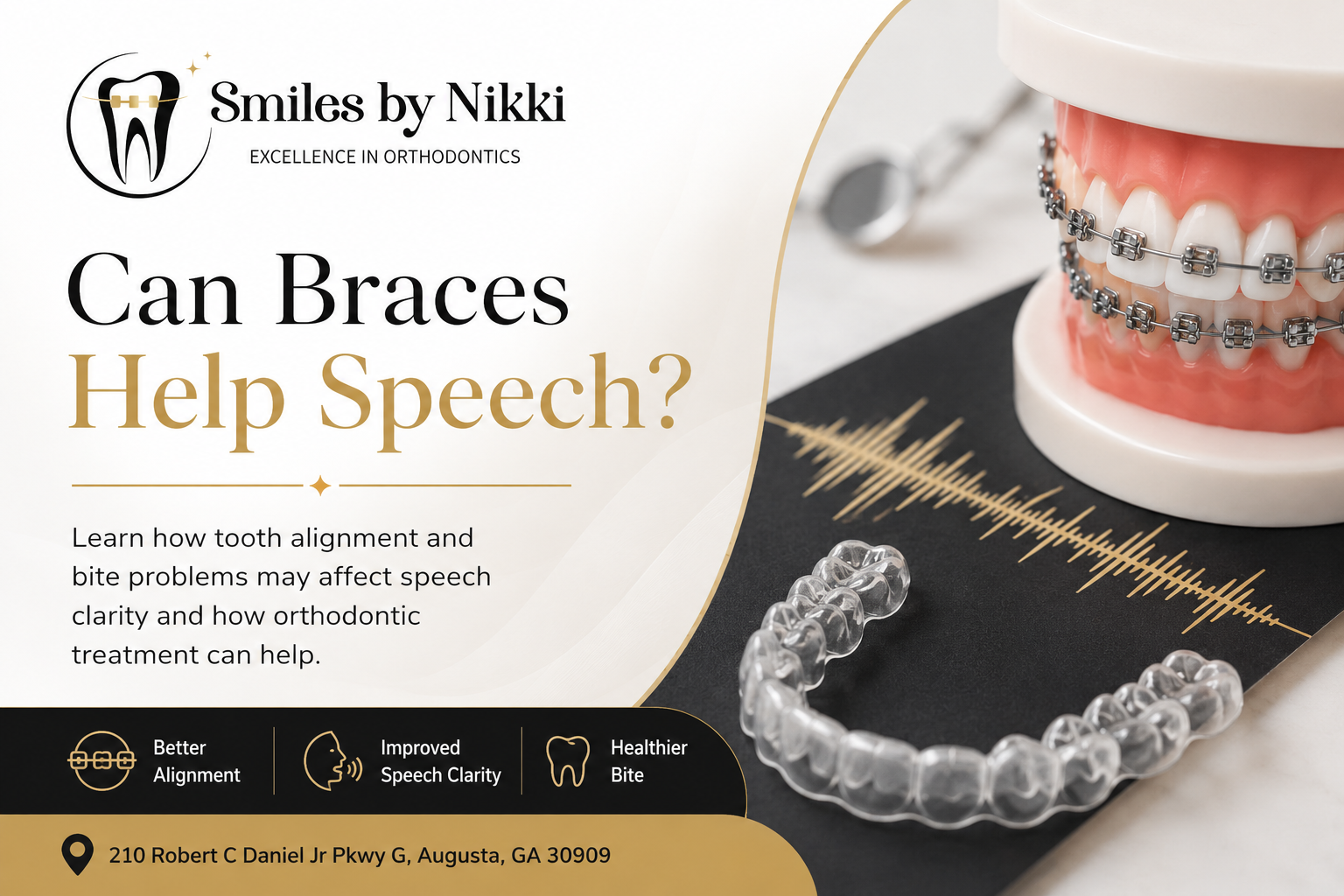
Can Braces or Aligners Improve Speech Problems?
Quick Answer: Braces or clear aligners may improve speech when crooked teeth, gaps, crowding, or an uneven bite makes certain sounds harder to form. They cannot correct every speech problem, so some patients may also need a speech-language pathologist.
Can Crooked Teeth Affect Speech?
Clear speech depends on the tongue, lips, teeth, and jaw working together. The tongue moves near or against the teeth and roof of the mouth to form sounds such as “s,” “t,” “d,” “th,” “f,” and “v.”
Crooked, crowded, tilted, or widely spaced teeth may affect tongue position or airflow. In some cases, spacing near the front teeth may change how an “s” sound is formed. Some people may notice a lisp, whistling, unclear words, or extra effort while speaking.
Speech can also be affected by hearing, tongue habits, muscle movement, development, or other health concerns. An evaluation is needed to determine whether the teeth or bite are involved.
Which Tooth and Bite Problems May Play a Role?
Gaps may change airflow, while severe crowding or tilted teeth may affect where the tongue can rest or move.
An open bite occurs when the front teeth do not meet and may allow the tongue to move between them during certain sounds. Overbites, underbites, and crossbites can also change how the teeth and jaws fit together.
Having one of these conditions does not mean speech will be affected. The result depends on the alignment issue, tongue position, and other individual factors.
Can Braces Make Speech Clearer?
Braces may help when a speech concern is partly related to tooth position or the bite. They move teeth gradually and may improve the structure the tongue and lips use while speaking.
Closing certain gaps may reduce unwanted airflow, while correcting an open bite may give the tongue a better resting position. Treating crowding can improve tooth alignment, but it does not guarantee a change in speech.
Braces may temporarily affect speech when first placed because the mouth needs time to adjust to the brackets and wires. Whether speech improves in the long term depends on the cause.
Can Clear Aligners Help?
Clear aligners may help when a speech concern is linked to spacing, crowding, or a bite problem that aligners can treat. The trays move teeth through a planned series of small changes and must be worn as directed.
Because aligners cover the teeth, some patients notice a temporary lisp, especially with “s” or “z” sounds. The tongue often adjusts as the patient becomes used to the trays.
At Smiles by Nikki, clear-aligner planning begins with an orthodontic evaluation and detailed 3D scans. Invisalign may be available when aligners are appropriate. The orthodontist determines whether aligners, braces, or another option best fits the patient’s needs.
When May Speech Therapy Be Needed?
Orthodontic treatment changes the position of the teeth and bite. It does not teach the tongue, lips, or mouth muscles how to form sounds.
A speech-language pathologist can assess concerns involving tongue placement, sound production, hearing, development, or muscle habits. Some patients may benefit from both orthodontic care and speech therapy.
For example, correcting an open bite may improve the tongue’s resting space, but speech therapy may still be needed if the tongue continues moving forward while speaking.
Should a Child See an Orthodontist or a Speech-Language Pathologist?
A child with crowding, an open bite, unusual jaw growth, or teeth that do not meet properly may benefit from an orthodontic evaluation.
A child with ongoing trouble making sounds, understanding language, or communicating clearly may also need a speech-language evaluation. One provider may recommend the other when both speech and dental structure appear relevant.
What Will the Orthodontist Check?
During an evaluation, Dr. Nikki Sangha can examine tooth alignment, spacing, crowding, jaw growth, and how the upper and lower teeth fit together. Photos, X-rays, or other records may also be taken when needed.
Patients or parents should explain which sounds are difficult, how long the concern has been present, and whether another healthcare provider has already completed an evaluation. This helps the orthodontist determine whether a tooth or bite problem may be contributing.
Questions to Ask Before Treatment
Patients and parents can ask whether the teeth or bite may be affecting speech, whether braces and aligners are both suitable, and whether the appliance may cause a temporary speech change.
It is also helpful to ask whether a speech-language evaluation should be considered and how the orthodontist will monitor the teeth and bite during treatment.
Frequently Asked Questions
Can Orthodontic Treatment Help?
Braces or clear aligners may help when crooked teeth, spacing, crowding, or an uneven bite contributes to unclear speech. They are less likely to help when the concern is mainly related to hearing, tongue habits, muscle movement, or development.
Smiles by Nikki provides orthodontic evaluations for children, teens, and adults in Augusta, Georgia. Patients can schedule a consultation to learn whether tooth or bite alignment may be part of the concern.