
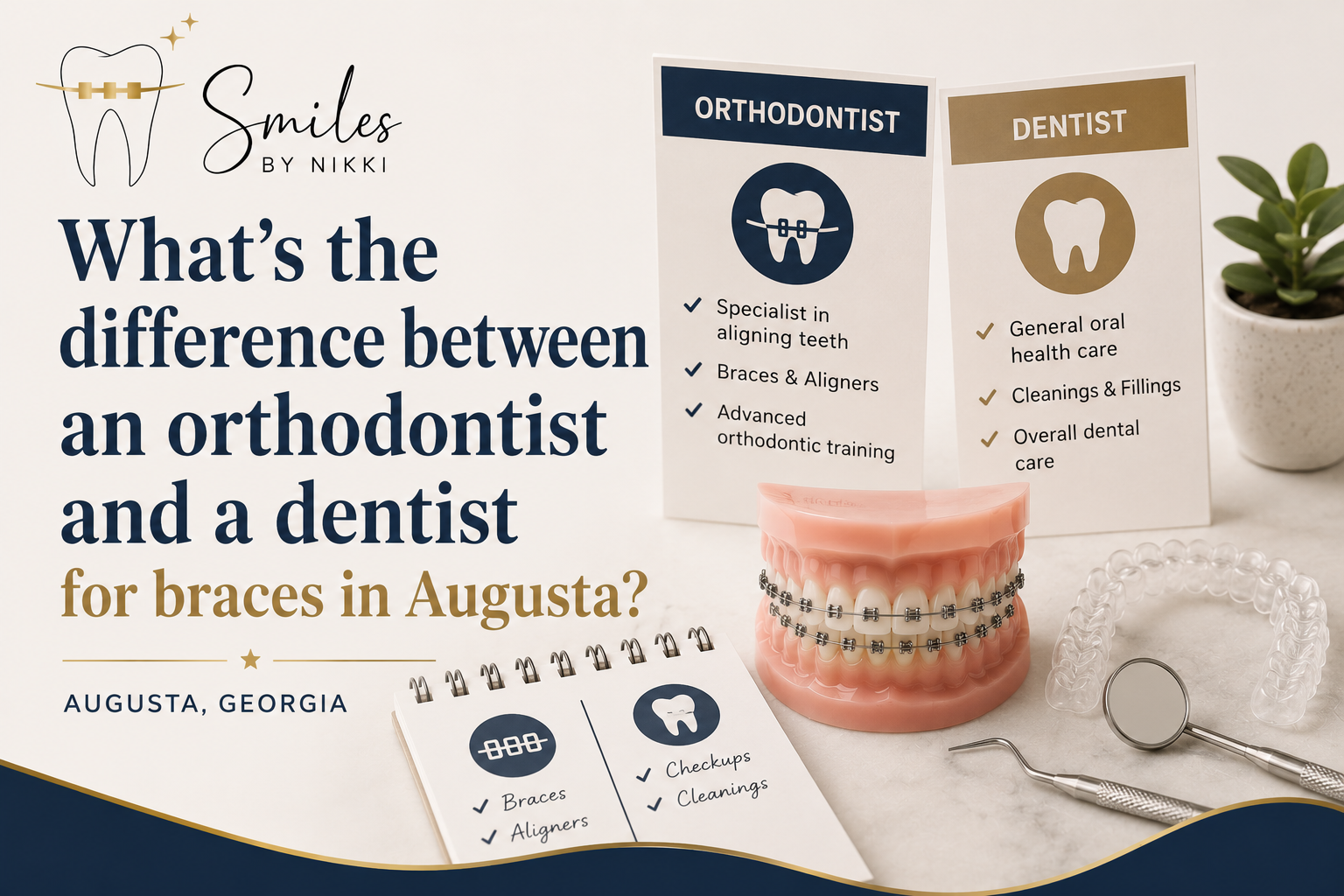
What’s the Difference Between an Orthodontist and a Dentist for Braces in Augusta?
Quick Answer:
Both dentists and orthodontists are licensed dental professionals, and some general dentists offer braces or clear aligners. The main difference is specialization: an orthodontist completes an additional 2–3 years of accredited residency training focused specifically on moving teeth, correcting bites, and managing jaw and facial development.
If you’re considering braces in Augusta, particularly for a child or for a more complicated bite problem, understanding that difference can help you choose the right provider. It’s easy to assume that the person who cleans your teeth should also be the person who straightens them. Sometimes a general dentist does provide orthodontic treatment, particularly clear aligners. But dentistry and orthodontics have different day-to-day focuses.
The better question isn’t simply, “Can my dentist straighten my teeth?” It’s who has the training and experience that best match the orthodontic problem you’re trying to solve?
Dentist vs. Orthodontist: What’s the Difference?
The simplest way to think about the distinction is that every orthodontist first becomes a dentist, but not every dentist becomes an orthodontist.
Both attend dental school and earn a DDS (Doctor of Dental Surgery) or DMD (Doctor of Dental Medicine) degree. After dental school, an orthodontist continues into an accredited orthodontic residency lasting an additional two to three years.
Here’s how the two roles generally compare:
| Factor | General Dentist | Orthodontist |
|---|---|---|
| Education | Dental school and DDS/DMD degree | Dental school and DDS/DMD + 2–3 years of orthodontic residency |
| Primary Focus | Overall oral and dental health | Tooth movement, bite correction and jaw/facial development |
| Typical Care | Exams, cleanings, fillings, crowns and other general dentistry | Braces, clear aligners, expanders, retainers and other orthodontic appliances |
| Orthodontic Treatment | Some dentists provide braces or clear aligners | Orthodontic treatment is the specialty’s primary focus |
| Complex Cases | May refer cases requiring specialist management | Trained to diagnose and manage a broad range of orthodontic problems |
Neither role replaces the other. In fact, your dentist and orthodontist often work together while you’re undergoing treatment.
What Extra Training Does an Orthodontist Have?
After completing dental school, orthodontists enter a full-time specialty residency devoted to orthodontics and dentofacial orthopedics.
That training goes beyond learning how to attach brackets or prescribe clear aligners. Orthodontists study how teeth move through bone, how the upper and lower jaws relate to one another, how facial structures grow and develop, and how changes in tooth position can affect the bite.
This becomes particularly relevant when treating children and teenagers whose jaws may still be developing.
For example, crooked front teeth may be the most visible concern, but an orthodontic examination could also identify an overbite, underbite, crossbite, spacing problem, impacted tooth, or another issue involving how the upper and lower teeth fit together.
The goal of orthodontic treatment isn’t simply to create straighter-looking front teeth. It’s to create an appropriate relationship between the teeth and bite while considering long-term stability.
Can a General Dentist Do Braces or Invisalign?
Yes. General dentists may provide orthodontic services when permitted within their training, competence, and state scope of practice. Clear aligner treatment is particularly common in some general dental practices.
That doesn’t make treatment inherently inferior. What matters is the provider’s training and experience and, more importantly, the needs of the individual patient.
A relatively straightforward alignment concern is different from a case involving significant crowding, an impacted tooth, jaw discrepancies, or a complex bite problem.
If your dentist identifies an orthodontic issue that would benefit from specialist care, they may refer you to an orthodontist. You can also schedule an orthodontic consultation directly if you want a specialist’s assessment before deciding how to proceed.
Are Orthodontists Only for Complicated Cases?
No. You don’t need to have severely crooked teeth or a major bite problem to see an orthodontist.
Orthodontists treat the full spectrum of tooth-alignment and bite concerns, from relatively minor spacing or crowding to complex malocclusions.
Someone interested primarily in improving the appearance of a few crooked teeth can still see an orthodontist. The advantage of an orthodontic evaluation is that the visible concern can be considered alongside the patient’s overall bite.
Sometimes what appears to be a simple cosmetic problem really is straightforward. Other times, moving those teeth affects neighboring teeth or how the upper and lower arches fit together.
An evaluation helps determine which situation applies to you.
Do Orthodontists Offer Invisalign and Clear Aligners Too?
Yes. Seeing an orthodontist doesn’t mean you’re limited to traditional metal braces.
Orthodontists can provide multiple treatment options depending on the patient’s needs, including conventional braces and clear aligners. The appropriate appliance depends on factors such as the type of tooth movement required, bite correction, patient age, treatment goals, and the patient’s ability to follow instructions for removable appliances.
Clear aligners can be an excellent treatment option for appropriate patients, but the aligner itself isn’t what diagnoses or plans the case.
Whether you receive braces or clear aligners, the treatment plan behind the appliance matters. Teeth need to move in carefully planned directions, and the provider needs to monitor that movement throughout treatment.
When Should You Consider Seeing an Orthodontist in Augusta?
An orthodontic consultation can be particularly useful if you or your child has noticeable crowding, gaps, protruding teeth, an overbite, underbite, crossbite, impacted teeth, or concerns about jaw development.
You may also want a specialist evaluation if previous orthodontic treatment has relapsed or if you’re uncertain whether braces or clear aligners would be more appropriate.
Children don’t need to wait until all of their permanent teeth have erupted before having their first orthodontic evaluation. The American Association of Orthodontists recommends an orthodontic check-up no later than age 7. This doesn’t mean a seven-year-old will automatically need braces. Rather, it gives an orthodontist an opportunity to identify developing problems and determine whether treatment should happen now or simply be monitored.
For adults, there is no equivalent “too late” age for an evaluation. Adults can pursue orthodontic treatment as long as their teeth and supporting structures are healthy enough for the planned movement.
Will I Still Need My Regular Dentist While I Have Braces?
Absolutely.
Choosing an orthodontist doesn’t mean replacing your general dentist.
Your orthodontist manages the movement and alignment of your teeth, while your dentist remains responsible for your routine oral healthcare. You’ll still need regular dental exams and professional cleanings while wearing braces or clear aligners.
That relationship becomes even more important during orthodontic treatment because brackets, wires, and other appliances can create additional areas where plaque and food collect.
Your dentist can monitor your teeth and gums for cavities, gum inflammation, and other oral health concerns while your orthodontist concentrates on your bite and tooth movement.
Think of them as two professionals working on different parts of the same goal.
Is an Orthodontist More Expensive Than a Dentist for Braces?
Not necessarily.
The provider’s professional title alone doesn’t tell you what your treatment will cost. Orthodontic fees can vary based on the complexity of the case, treatment length, type of appliance, insurance benefits, and what’s included in the treatment package.
A lower initial quote also isn’t necessarily a lower total cost.
When comparing orthodontic treatment in Augusta, ask each provider what the quoted fee includes. Find out whether appointments, X-rays or scans, emergency visits, retainers, refinements, and post-treatment follow-up are included or billed separately.
It makes more sense to compare complete treatment plans than to compare a single advertised price.
What Should You Ask Before Choosing a Braces Provider?
Whether you’re considering treatment through your dentist or an Augusta orthodontist, ask about the provider’s experience with cases like yours and why a particular treatment is being recommended.
You can also ask what orthodontic problem is being corrected beyond the visible crooked teeth, whether braces and clear aligners are both reasonable options, how long treatment is expected to take, what’s included in the total fee, and how the office handles unexpected changes during treatment.
For parents, it can also be helpful to ask whether treatment is necessary immediately or whether monitoring growth and development would be more appropriate.
A good consultation should leave you understanding what is being treated and why, rather than simply knowing which appliance you’ll receive.
Choosing an Orthodontist in Augusta, GA
If you decide that specialist orthodontic care is right for you or your child, look beyond braces brands and promotional offers.
Consider the orthodontist’s training, treatment philosophy, communication style, available treatment options, office accessibility, and how comfortable you feel asking questions.
For families in Augusta and surrounding communities, Smiles by Nikki is an orthodontic practice led by Dr. Nikki Sangha and provides specialist orthodontic care for children, teens, and adults. Treatment options include traditional braces and clear aligners, allowing treatment to be planned around the patient’s individual tooth alignment and bite needs.
The most important thing is finding a provider who can clearly explain what they see, what they recommend, and how the proposed treatment addresses your particular orthodontic problem.
Frequently Asked Questions
Can a regular dentist put braces on your teeth?
Some general dentists provide orthodontic treatment, including braces or clear aligners. Orthodontists differ because they complete an additional accredited specialty residency focused specifically on orthodontics after earning their dental degree.
Is an orthodontist better than a dentist for Invisalign?
The answer depends on the patient’s needs rather than the Invisalign brand itself. Both may provide clear aligner treatment, but orthodontists have additional specialty training in tooth movement and bite correction. More complicated alignment or bite concerns may particularly benefit from specialist evaluation.
Should my child see a dentist or orthodontist first?
Your child should have a regular dentist for routine oral healthcare, and you don’t necessarily need to wait for a dental referral to schedule an orthodontic evaluation. The AAO recommends that children have their first orthodontic check-up by age 7.
Do I need a referral to see an orthodontist?
Many patients can contact an orthodontic practice directly without a referral. However, insurance requirements vary, so check your specific dental plan if you’re relying on insurance benefits.
Do I still need dental cleanings while wearing braces?
Yes. Regular dental exams and cleanings remain important throughout orthodontic treatment. Your orthodontist manages tooth movement and your bite, while your general dentist continues monitoring your overall dental and gum health.
Can adults see an orthodontist?
Yes. Orthodontic treatment isn’t limited to children and teenagers. Adults can be evaluated for braces or clear aligners, with treatment recommendations based on their dental health, bite, and individual goals.
Dentist or Orthodontist: Which Should You Choose for Braces?
A general dentist and an orthodontist can both play important roles in your oral health, but they don’t have identical training or focus.
If you’re specifically seeking braces, clear aligners, or an evaluation of your bite, an orthodontist offers additional specialty training devoted to tooth movement and jaw alignment. A general dentist remains essential for maintaining healthy teeth and gums before, during, and after orthodontic treatment.
If you’re unsure which type of provider you need, you don’t have to make the decision based on guesswork. An orthodontic consultation can identify whether the concern is straightforward or more complex and explain the treatment options available.
For patients in Augusta, Evans, Grovetown, and surrounding communities, Smiles by Nikki offers orthodontic evaluations and treatment for children, teens, and adults. A consultation can help you understand not just how your smile could look different, but what may need to change in your bite to get there.