
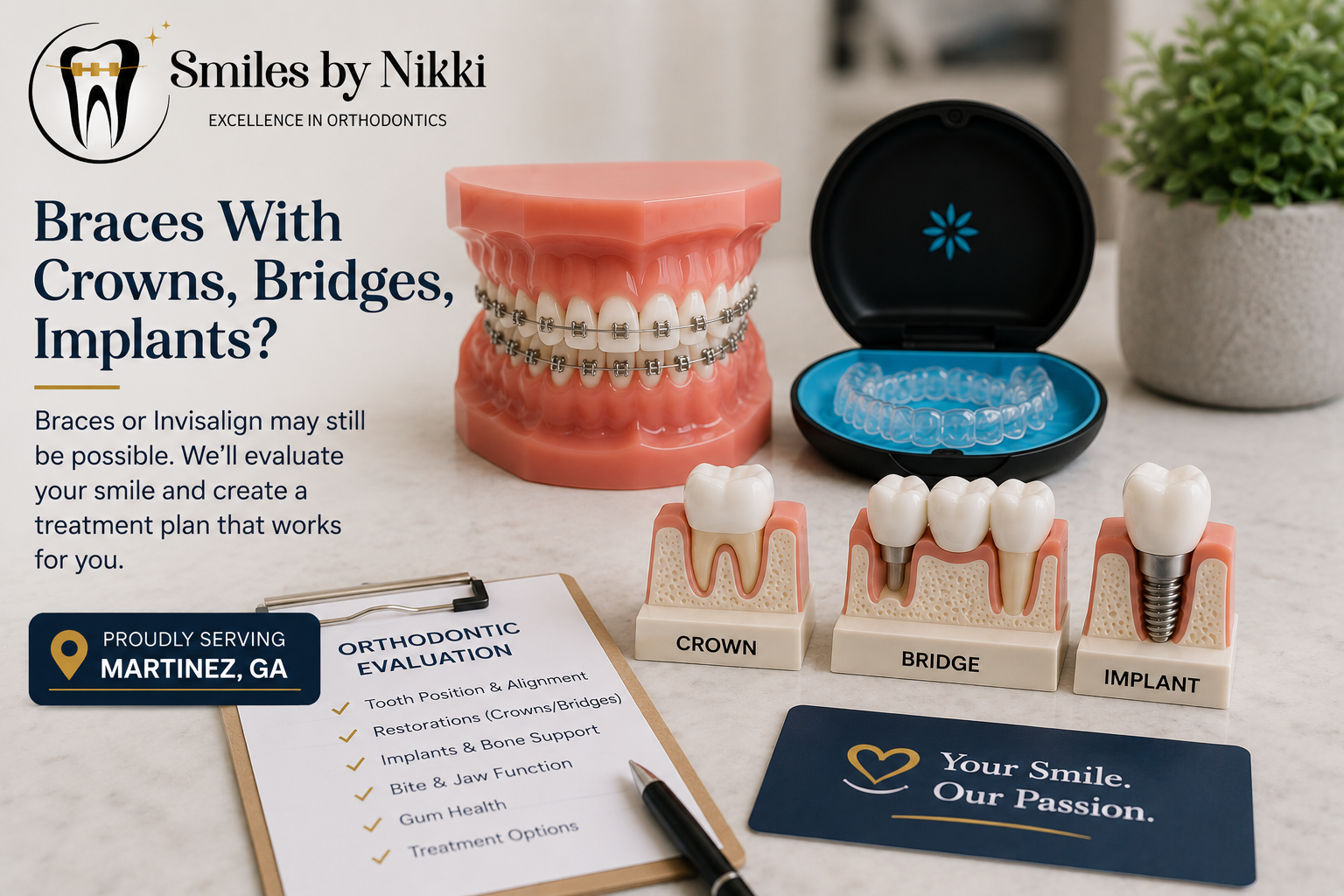
Can I Get Braces or Invisalign If I Have Crowns, Bridges, or Implants?
Quick answer:
Yes, many patients can get braces or Invisalign if they have crowns, bridges, or implants, but the treatment plan needs to be carefully reviewed first. Crowns usually move with the natural tooth underneath, bridges may limit how certain teeth can move, and implants do not move like natural teeth. You should not assume you are not a candidate just because you have dental restorations; many adults can still improve their smile with the right orthodontic plan.
Can You Get Braces With Crowns?
Yes, you may be able to get braces if you have crowns. A crown covers a natural tooth, but the tooth root is still there. Because of that, the tooth can often move during orthodontic treatment.
The main difference is bonding. Brackets may not attach to a crown the same way they attach to natural enamel. Your orthodontist may need to use a different bonding method or be more careful when placing brackets.
If a crown is older, loose, cracked, or poorly fitting, your orthodontist may want your dentist to check it before treatment starts.
Can You Get Invisalign With Crowns?
Yes, Invisalign or other clear aligners may be possible if you have crowns. In many cases, aligners can fit over crowned teeth and move them along with the rest of the smile.
Your orthodontist will check whether the crown shape affects how the aligner fits. In some cases, attachments may need to be placed on crowned teeth, and bonding to crowns can be different than bonding to natural teeth.
If aligners do not grip a crowned tooth well, your orthodontist may adjust the plan or use a different approach.
Can You Get Braces or Invisalign With a Bridge?
Bridges are more complicated than crowns. A dental bridge is usually connected to more than one tooth and may replace a missing tooth. Because the teeth in a bridge are joined together, they may not move independently.
This does not always mean orthodontic treatment is impossible. It means your orthodontist needs to plan around the bridge.
In some cases, the bridge can stay in place during treatment. In other cases, your orthodontist may recommend working with your dentist to decide whether the bridge should be adjusted, replaced, or planned around after orthodontic treatment.
Can You Get Braces or Invisalign With Dental Implants?
Yes, some patients can still get braces or Invisalign if they have dental implants. However, implants are different from natural teeth.
A dental implant is fixed in the jawbone. It does not move the same way a natural tooth moves with braces or aligners. Because of that, your orthodontist cannot move the implant into a new position.
Instead, the treatment plan must work around the implant. Sometimes an implant can even help as a stable point in the plan. Other times, it may limit how much the surrounding teeth can move.
When Treatment May Be Possible
| Dental work | Can braces or Invisalign still work? | What your orthodontist will check |
| One crown | Often, yes | Crown condition, bonding, and tooth movement needed |
| Several crowns | Often, yes | Bite, crown placement, and attachment options |
| Dental bridge | Case by case | Whether connected teeth need to move separately |
| Dental implant | Case by case | Implant position and surrounding tooth movement |
| Missing tooth space | Often, yes | Whether space should be closed, opened, or held |
| Older dental work | Maybe | Whether restorations are stable before treatment |
This table is only a general guide. Your orthodontist needs to review your teeth, bite, X-rays, and dental history before deciding what is safe.
What Your Orthodontist Checks First
Before recommending braces or Invisalign, your orthodontist will review your smile as a whole. This includes your natural teeth, crowns, bridges, implants, bite, spacing, crowding, and gum health.
They may also look at X-rays to see tooth roots, bone support, missing teeth, and implant position. If you have a bridge or implant, the exact location matters.
Your orthodontist may also check gum health and bone support, especially for adult patients with older dental work or a history of gum disease.
At Smiles by Nikki, this planning step helps patients understand what can move, what cannot move, and what treatment path makes the most sense.
Why Your Dentist May Be Involved
If you have crowns, bridges, or implants, your orthodontist may need to coordinate with your general dentist.
Your dentist understands the condition of your existing dental work. Your orthodontist understands how the teeth need to move. Together, they can help protect your restorations while planning for a healthier, straighter smile.
This is especially important if a crown needs to be replaced, a bridge may need future adjustment, or an implant affects the way your teeth can move.
Should You Get Braces Before or After an Implant?
If you are missing a tooth and do not have an implant yet, orthodontic treatment may need to happen before implant placement.
This is because natural teeth can move, but implants cannot. If an implant is placed before the teeth are in the right position, it may limit future orthodontic options.
For some patients, orthodontics can create the right amount of space for a future implant. For others, orthodontics may close a space so an implant is not needed. Your orthodontist and dentist can help decide the right order.
Can Braces Damage Crowns, Bridges, or Implants?
Braces and clear aligners are designed to use controlled force. When treatment is planned carefully, many patients with crowns, bridges, or implants can move forward safely.
Existing dental work simply needs extra attention. A bracket may be harder to bond to a crown. A bridge may not respond like separate natural teeth. An implant will not move. These details do not automatically make treatment risky, but they do affect the plan.
The goal is to move the teeth that can move, avoid unnecessary stress on restorations, and protect your bite and long-term dental health.
Is Invisalign Better Than Braces If I Have Dental Work?
Invisalign may be a good option for some patients with crowns, bridges, or implants, but it is not automatically better.
Clear aligners can be easier for brushing and flossing because they are removable. They may also avoid some bracket-bonding issues on crowns. However, aligners still need to grip the teeth properly and move them predictably.
Braces may be better for more complex movement or bite correction. The right choice depends on your dental work and your treatment goals.
What If My Crown or Bridge Needs to Be Replaced?
If a crown or bridge needs to be replaced soon, your orthodontist may recommend talking with your dentist before starting treatment.
In some cases, it may be better to complete orthodontic treatment first and replace the restoration afterward. This can help the final crown or bridge match your new tooth positions.
In other cases, dental work may need to be repaired first so orthodontic treatment can begin safely.
What If I Already Have an Implant in the Wrong Spot?
If an implant is already placed and the surrounding teeth have shifted, your orthodontist will need to evaluate the situation carefully.
The implant itself cannot be moved with braces or aligners. However, the natural teeth around it may be able to move into better positions.
Sometimes treatment can improve the overall smile even if the implant stays where it is. Other times, your dentist or specialist may need to discuss additional options.
Local Orthodontic Care Near Martinez, GA
Patients in Martinez, Augusta, Evans, Grovetown, and nearby Georgia communities often ask whether they can get braces or Invisalign with crowns, bridges, implants, or missing teeth.
Dr. Nikki Sangha, DMD, provides personalized orthodontic care for children, teens, and adults. For patients with existing dental work, the goal is to create a plan that respects both the smile goals and the dental restorations already in place.
If you are unsure whether your crown, bridge, or implant affects your options, an orthodontic consultation can give you a clear answer.
Questions to Ask at Your Consultation
Before starting braces or Invisalign, ask your orthodontist how your dental work may affect treatment.
You may want to ask:
Can my crowned teeth move safely?
Will brackets or attachments bond to my crowns?
Will my bridge limit tooth movement?
How will my implant affect the treatment plan?
Should any dental work be replaced before or after orthodontic treatment?
Will my dentist need to be involved?
These questions can help you understand your options before making a decision
Frequently Asked Questions About Braces, Invisalign, Crowns, Bridges, and Implants
Schedule a Free Orthodontic Consultation
If you have crowns, bridges, implants, or missing teeth, you may still have options for braces or clear aligners.
Smiles by Nikki helps patients in Martinez, Augusta, Evans, Grovetown, and nearby communities understand their orthodontic options with clear, honest guidance. Schedule a free consultation with Dr. Nikki Sangha, DMD, to find out whether braces, clear aligners, or a coordinated orthodontic and dental treatment plan makes sense for your smile.