
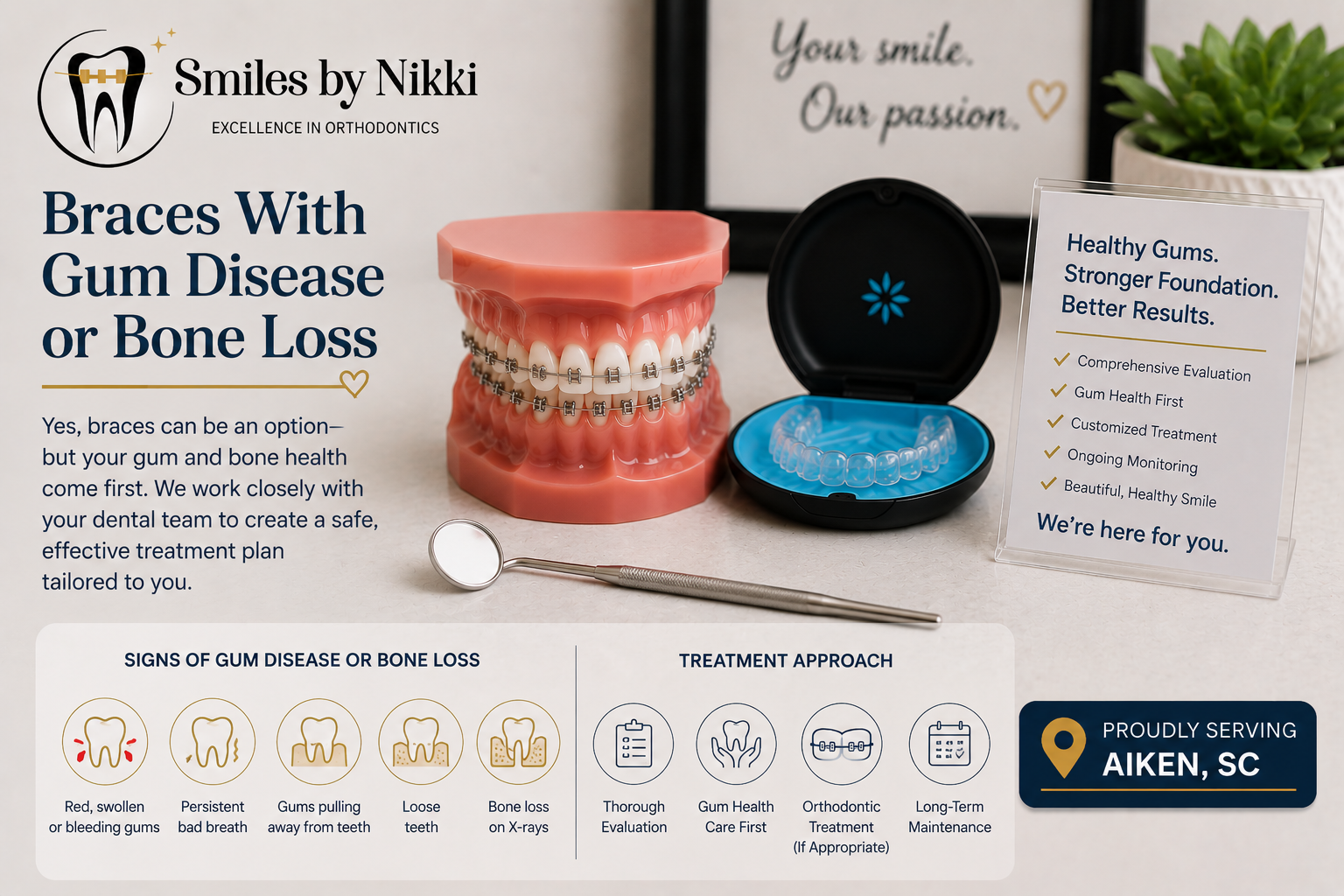
Can I Get Braces If I Have Gum Disease or Bone Loss?
Quick answer:
Yes, you may be able to get braces or clear aligners if you have gum disease or bone loss, but your gum health must be stable enough for safe tooth movement first. Treatment may be possible if your gum disease is controlled, your teeth are stable, and your orthodontist confirms that your bone support can handle orthodontic movement. If you have active gum disease, bleeding gums, loose teeth, untreated infection, or advanced bone loss, braces or clear aligners may need to wait until your gum health is under control.
Who This Blog Is For
This guide is especially helpful for adults who have been told they have periodontal disease, gum recession, bone loss, loose teeth, or a history of deep cleanings.
It can also help if you had braces years ago, your teeth have shifted, and you now worry that your gums or bone support may affect your treatment options.
When Braces or Clear Aligners May Be Possible
| Your gum health situation | Can orthodontic treatment start? | What may need to happen first |
| Mild gum inflammation | Maybe, but not always right away | Cleaning, better home care, and dental clearance |
| Active gum disease | Usually no | Gum disease should be treated and controlled first |
| Stable history of gum disease | Possibly | Orthodontic exam, X-rays, and careful monitoring |
| Mild bone loss | Possibly | Treatment may use lighter forces and closer checks |
| Moderate or severe bone loss | Case by case | Coordination with a dentist or periodontist may be needed |
| Loose teeth | Not until evaluated | Tooth stability and bone support need to be checked first |
This table is only a general guide. Your actual answer depends on your exam, X-rays, gum measurements, tooth stability, and dental history.
Why Gum Health Matters Before Braces
Braces and clear aligners work by moving teeth through the bone. For that movement to be safe, the gums, bone, and tissues around the teeth need to be healthy enough to support the process.
If the gums are inflamed or infected, moving the teeth too soon can create more problems. It may increase discomfort, worsen gum recession, or put too much stress on teeth that already have weak support.
That does not mean orthodontic treatment is impossible. It means your orthodontist needs to understand your gum health before recommending a treatment plan.
What Is Gum Disease?
Gum disease is an infection or inflammation of the tissues around the teeth. In the early stage, often called gingivitis, the gums may look red, swollen, or bleed when brushing and flossing.
If gum disease gets worse, it can become periodontitis. This can damage the bone and tissues that hold the teeth in place. Over time, untreated periodontal disease may lead to gum recession, loose teeth, shifting teeth, and tooth loss.
Because gum disease affects the foundation of your smile, it must be controlled before orthodontic movement begins.
What Does Bone Loss Mean for Orthodontic Treatment?
Bone loss means there is less bone supporting one or more teeth. This can happen because of gum disease, aging, missing teeth, infection, trauma, or other dental problems.
If you have mild bone loss, braces or clear aligners may still be possible. Your orthodontist may use lighter forces, move teeth more slowly, and monitor your progress more closely.
If bone loss is moderate or severe, treatment becomes more complex. Some teeth may not be safe to move very far. In those cases, your orthodontist may work with your dentist or periodontist to decide what is realistic and safe.
Can Braces Make Gum Disease Worse?
Braces do not cause gum disease by themselves. However, braces can make it easier for plaque to collect around brackets and wires if cleaning is not consistent.
If gum disease is already active, braces may make the problem harder to manage. That is why orthodontic treatment usually needs to wait until the gums are healthier and infection is under control.
Clear aligners may be easier to clean around because they are removable. Still, they are not a shortcut around gum disease. Your gums and bone still need to be healthy enough for tooth movement.
Can I Get Invisalign With Gum Disease or Bone Loss?
Some patients with a history of gum disease or mild bone loss may be candidates for Invisalign or other clear aligners. This depends on how stable the gums are, how much bone support remains, and what type of tooth movement is needed.
Clear aligners can be helpful for some adults because they are removable for brushing and flossing. That can make home care easier during treatment.
Even so, aligners still move teeth. If gum disease is active or teeth are loose, treatment may need to wait until your dentist or periodontist confirms that your oral health is stable.
What Your Orthodontist Checks First
Before deciding whether braces or clear aligners are safe, your orthodontist may look at several things.
This can include X-rays, gum recession, tooth mobility, bite problems, spacing, crowding, bone levels, and your history of periodontal treatment. If you have had deep cleanings, gum surgery, or ongoing periodontal maintenance, that information matters.
Your orthodontist may also ask whether your gums bleed often, whether any teeth feel loose, and whether your dentist has told you that your gum disease is active or stable.
Why a Dentist or Periodontist May Be Involved
For patients with gum disease or bone loss, orthodontic care may need to be planned with both an orthodontist and a dentist or periodontist.
The periodontist or dentist helps manage the health of the gums and bone. The orthodontist plans how the teeth can move safely. When both sides are working together, the treatment plan is usually safer and more realistic.
This team approach is especially important for adults with periodontal history, gum recession, loose teeth, or bone loss around certain teeth.
What Needs to Happen Before Treatment Starts?
If you have gum disease or bone loss, the first step is not choosing braces or aligners. The first step is finding out whether your gums are healthy enough for orthodontic treatment.
You may need a dental cleaning, periodontal treatment, improved home care, or clearance from your dentist or periodontist before starting. If your gum disease is active, it should be controlled first.
Once your gums are stable, your orthodontist can decide whether braces, clear aligners, limited treatment, or another option makes sense.
How Treatment May Be Adjusted
If you are approved for orthodontic treatment with bone loss or periodontal history, your plan may look different from a standard case.
Your orthodontist may move teeth more slowly. They may use lighter pressure. They may recommend shorter check-in intervals or ask you to keep up with more frequent cleanings.
The goal is not just to straighten your teeth. The goal is to improve your smile while protecting your long-term oral health.
Who May Need Extra Evaluation?
You may need a more detailed evaluation if you have loose teeth, heavy gum recession, advanced bone loss, bleeding gums, deep periodontal pockets, or a history of gum surgery.
You may also need extra evaluation if your teeth have shifted because of gum disease. Shifting, spacing, and flaring can sometimes happen when the support around the teeth changes.
In these cases, orthodontic treatment may still be possible, but it needs careful planning.
Can Orthodontic Treatment Help Gum Health?
Orthodontic treatment does not cure active gum disease. If you have infection or inflammation, that needs to be treated by your dentist or periodontist.
However, straightening teeth may make them easier to clean in some cases. Crowded or overlapping teeth can trap plaque and make brushing and flossing harder.
When orthodontic treatment is done at the right time, with healthy gums and good home care, it may support better long-term maintenance. It should not be used as a replacement for periodontal treatment.
Braces vs. Clear Aligners for Patients With Gum Concerns
Both braces and clear aligners can work for the right patient. The better option depends on your gum health, tooth movement needs, bite, bone support, and daily habits.
Braces may be better for more complex movement. Clear aligners may be easier for brushing and flossing because they can be removed.
The safest choice is the one that fits your oral health, not just the one that looks more convenient.
Local Orthodontic Care in Augusta, GA
Patients in Augusta, Martinez, Evans, Grovetown, and nearby Georgia communities often come to Smiles by Nikki with questions about adult orthodontics, clear aligners, braces, and gum health.
Dr. Nikki Sangha, DMD, provides personalized orthodontic care for children, teens, and adults. For patients with gum disease, bone loss, or periodontal history, the goal is to give honest guidance before treatment begins.
If braces or clear aligners are not safe right away, that does not mean you are out of options. It may simply mean your gums need attention first.
Questions to Ask at Your Consultation
If you have gum disease or bone loss, ask whether your gums look stable enough for tooth movement. You can also ask whether your dentist or periodontist should be involved before treatment starts.
It may help to bring recent X-rays, periodontal records, or notes from your dentist if you have them. This gives your orthodontist more information when reviewing your options.
The more complete the picture, the safer and more personalized your orthodontic plan can be.
Frequently Asked Questions About Braces, Gum Disease, and Bone Loss
Schedule an Orthodontic Consultation
If you have gum disease, bone loss, gum recession, or concerns about whether braces are safe for you, the best next step is a personalized orthodontic evaluation.
Smiles by Nikki helps patients in Augusta, Martinez, Evans, Grovetown, and nearby Georgia communities understand their options with clear, honest guidance. Schedule a consultation with Dr. Nikki Sangha, DMD, to find out whether braces, clear aligners, or another treatment path makes sense for your smile and long-term oral health.